

About the Project
About the Project
The project ReFresh Fish LIFE Improving the conservation status of endangered freshwater fish species that are endangered or in unfavourable-bad conservation status in Šibenik-Knin and Split-Dalmatia Counties addresses key challenges that threaten the conservation of five endemic and endangered freshwater fish species in Šibenik-Knin and Split-Dalmatia Counties. These species – the Visovac goby (Knipowitschia mrakovcici), Dalmatian minnow (Phoxinellus dalmaticus), Dalmatian barbelgudgeon (Aulopyge huegelii), Tursky’s dace (Telestes turskyi) and Dinaric minnow (Phoxinellus alepidotus) – are listed as endangered or critically endangered on the IUCN Red List and have been assessed as having an unfavourable conservation level (U1 or U2) at the EU biogeographic level.
All five species are limited to just a handful of river systems, and face intensive pressures due to alien and invasive species, pollution, hydrological changes, habitat fragmentation, and a lack of data about their ecological requirements. The project is to be carried out within four key sites of Natura 2000 ecological network: Broader area of Krka National Park (HR2000918), Čikola River (HR2000919), Vrba River (HR2001266) and the Central course of the Cetina River with the Hrvatačko Polje and Sinjsko Polje fields (HR2001313). Together, these areas represent the only places in the world where three target species and a large part of the global populations of the other two species can be found. The project plans active measures to preserve the original biodiversity of fish species and degraded freshwater ecosystems.
Project acronym: LIFE24-NAT-HR-Refresh Fish LIFE
Project number: 101216203
Project duration: 1/9/2025 – 31/8/2030
Project objectives
Project objectives
- Improve the conservation status of threatened and critically endangered freshwater fish species by controlling alien and invasive fish species in four Natura 2000 sites
- Restore degraded habitats, including riparian vegetation, submerged ecosystems, and natural water flows, while also improving the ecological base of knowledge to support evidence-based protection
- Prevent the introduction and spread of alien and invasive species with specific measures (e.g., electro barriers) and stakeholder engagement
- Build institutional capacities and strengthen long-term management in Natura 2000 sites by equipping local public institutions and rangers with tools, training, and the adoption of guidelines
- Establish comprehensive monitoring of ecological and socioeconomic impacts to assess the efficacy of actions, ensuring adaptability of project management
- Raise awareness and stimulate the engagement of recreational fishers, farmers, schoolchildren, and the general public, by building a common understanding of the biodiversity of freshwater and threats posed by alien and invasive species.
Project area
Project area
The project is to be carried out within four Natura 2000 ecological network sites: Broader area of Krka National Park (HR2000918), Čikola River (HR2000919), Vrba River (HR2001266) and the Central course of the Cetina River with the Hrvatačko Polje and Sinjsko Polje fields (HR2001313).
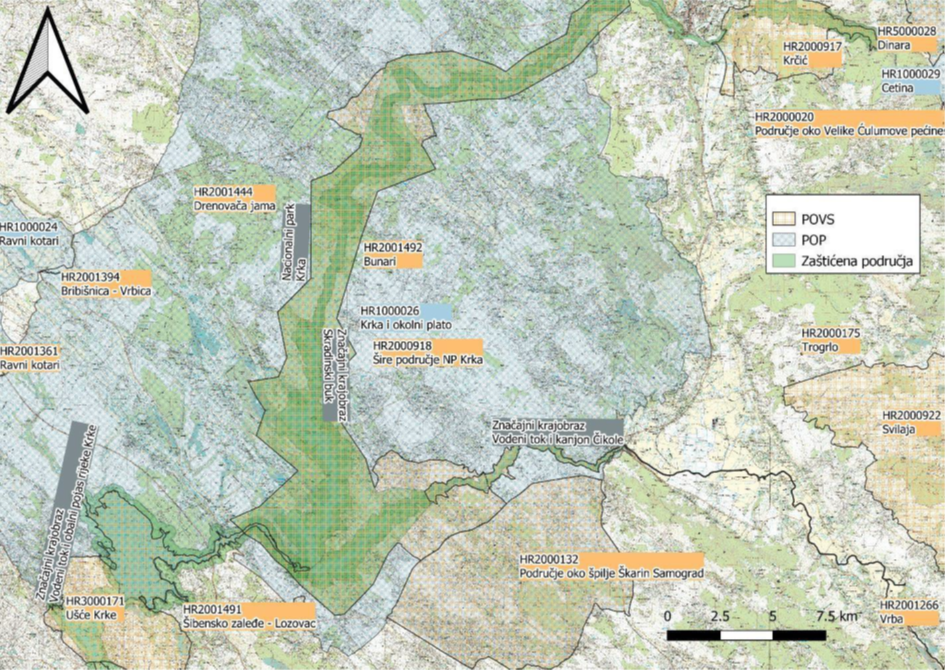
Wider area of the National Park Krka (HR2000918)
The Natura 2000 site Šire područje NP Krka (HR2000918) (eng. “Wider area of the National Park Krka) covers an area of 13,158.89 ha. The largest part of the area is overlapped with the "Krka" National Park. Both Krka National Park area as well as the part of the NATURA2000 site Krka (HR2000918) are managed by the Public Institution "National Park Krka". The site harbours 100% of the known population of the endemic species Knipowitschia mrakovcici. The site is one of the three sites important for the endemic species Phoxinellus dalmaticus and target species Aulopyge huegelii (with the biggest part of Croatian population (45-60%)
Čikola River (HR2000919)
The Čikola NATURA2000Ecological Network Area (HR2000919) covers the area of the Čikola River, the main tributary of the Krka River. Part of the area is located within the National Park "Krka" and is managed by the Public Institution "Krka National Park". The remaining part of the area outside the borders of the National Park is managed by the Public Institution Nature of the Šibenik-Knin County. The Čikola Ecological Network Area is one of three areas important for the species Phoxinellus dalmaticus and makes up the largest part of the Croatian population (45-60%) of this species, and the area is also important for the endemic species Telestes tursky and the target species Aulopyge Huegelii.
Vrba River (HR2001266)
The Vrba NATURA2000 Ecological Network Area (HR2001266) covers the area of the Vrba River. The part of the Vrba River located in Šibenik-Knin County is managed by the Public Institution Nature of Šibenik-Knin County, and the part located in Split-Dalmatia County is managed by the Public Institution Sea and Karst. The Vrba Ecological Network Area is one of three areas important for the species Phoxinellus dalmaticus, and together with the Čikola Ecological Network Area (HR2000918), it represents the only area in the world inhabited by the endemic species Telestes tursky.
Central course of the Cetina River with the Hrvatačko Polje and Sinjsko Polje fields (HR2001313)
The project also includes the Miloševo and Stipančevo Lakes, which are part of the ecological network area of the Middle Cetina River with the Croatian and Sinj Fields (HR2001313) and are managed by the “Sea and Karst” Public Institution. Miloševo and Stipančevo Lakes are an important area for the fish species Phoxinellus alepidotus, whose populations in Croatia (and thus the EU) live only in these lakes.
Project partners
Coordinating beneficiary
Public Institution "Krka National Park"
The public institution "Krka National Park" manages the territory of the Krka National Park. The founder of the public institution is the Republic of Croatia, and the founding rights and duties are performed on behalf of the Republic of Croatia by the state administration body responsible for nature protection, i.e. the competent Ministry. In accordance with the Act on nature protection, the activity of the Krka National Park Public Institution is the protection, maintenance and promotion of the protected area in order to protect and preserve the originality of nature, ensuring the undisturbed development of natural processes and sustainable use of natural resources, monitoring the implementation of conditions and measures for nature protection in the area it manages, and participation in data collection for the purpose of monitoring the state of nature conservation (monitoring). In addition, JU performs a number of other activities such as receiving, guiding and transporting visitors, informing visitors, public information activities, organizing exhibitions and fairs.
Krka National Park is located in Šibenik-Knin County and covers an area of 109 km² of the loveliest part of the Krka River and the lower course of the Čikola River. This area was proclaimed a national park due to the geomorphological, hydrological and landscape values, with tufa as the fundamental phenomenon. The plant and animal life of Krka National Park is both rich and diverse, with numerous endemic, rare and endangered species. Numerous cultural and historical monuments also lie within the park boundaries, such as archaeological sites, medieval fortresses, ethnography, sacral heritage monuments, and industrial architecture monuments.
Project partners
Ministry of Environmental Protection and Green Transition - The Institute for Environment and Nature
The Institute for Environment and Nature within the Ministry of Environmental Protection and Green Transition is one of the central institutions within the nature protection sector in Croatia. Among other roles, the Institute is conducting professional and analytical tasks in the field of nature and environmental protection, collects and consolidates data and information on all environmental components and pressures on the environment and nature, manages and develops environmental and nature information systems, prepares analysis, reports and expert backgrounds on the state of the environment and nature, as well as expert opinions on nature conservation and sustainability of the use of natural resources, including protected areas and ecological network sites. The Institute for Environmental and Nature Protection deals with various administrative and professional tasks related to the conservation of terrestrial and freshwater habitats and threats such as alien and invasive alien species.
University of Zagreb, Faculty of Science
The Faculty of Science is one of the leading regional university institutions for scientific and educational work and expertise in the fields of natural sciences and mathematics in the Republic of Croatia. Ichthyological investigation have long-term tradition at the Faculty of Science, with attention focused on estimations of structures and states of fish communities, as well as designing and implementing conservation plans for aquatic ecosystems. Furthermore, for more than a decade, scientists from the Faculty of Science are involved in the methodology development and estimation of the hydro morphological and ecological states/potentials of various water bodies in Croatia. During that process, they have analysed hydro morphological and other pressures on fish communities and identified answers of various fish community components to each pressure. Thereafter, Faculty of Science is involved in the implementation of Water Framework Directive in Croatia on several levels – methodology development, research activities and conservational activities that include invasive species removal.
The Public Institution „SEA AND KARST“
The Public Institution More i krš carries out the activity of protection, maintenance and promotion of protected areas and areas of the ecological network of the Split-Dalmatia County with the aim of protecting and preserving the authenticity of nature, ensuring the undisturbed development of natural processes and sustainable use of natural resources, and supervising the implementation of conditions and measures for nature protection in the protected areas it manages. The institution manages a part of the Natura 2000 ecological network area Vrba (HR2001266) and the Middle course of the Cetina River with the Hrvatačko and Sinj Fields (HR2001313) - Miloševo and Stipančevo Lakes, which are located in the Split-Dalmatia County and have been designated as a project area, and therefore the Institution is a key partner in the implementation and supervision of field project activities.
The Public Institution „NATURE“ of Šibenik-Knin County
The “Nature” Public Institution of the Šibenik-Knin County was established in 2007 and manages 7 protected areas, 54 Natura 2000 sites and 1 UNESCO cultural heritage site. The activities of the Public Institution include the protection, maintenance and promotion of protected areas with the aim of protecting and preserving the natural origin, ensuring the sustainable use of natural resources and monitoring the state of preservation of natural and cultural heritage. The Public Institution is also a key partner in the implementation of project activities, as they take place in part of the NATURA 2000 sites Čikola (HR2000919) and Vrba (HR2001266) that are managed by the Institution.
Associated Partners
Croatian Waters PE
Croatian Waters is a legal entity for water management in the Republic of Croatia in order to protect life, health and property from the harmful effects of water and to ensure the permanent availability of water by optimizing economic and ecological benefits based on the principles of sustainable development. Croatian Waters, as an associated partner, will closely cooperate with project partners through the implementation of a methodology for determining the optimal ecological flow, which is the basis for the criterion for achieving good water status.
Sport Fishing Association "Krka" Knin
The Sport Fishing Association "Krka" Knin is a local association of recreational fishermen that will participate as an associated partner in the implementation of education activities of association members, the implementation of the Manual on Selective Fishing, and activities to remove invasive fish species in the Krka River. Furthermore, the experts from SRD Krka-Knin will be part of the working group of experts from Faculty of Science, National Park Krka Public Institution and The Institute for Environment and Nature Protection that will identify the best solutions blocking pathways of introduction of alien species to the Krka River as well as actively involved in the implementation / installation of the chosen solution as associated partner and will support PI – NP Krka and FOS in subsequent monitoring activities.
Funding
Funding
Total project budget: 4.048.272,24 €.
EU co-financing: 3.036.203,00 €
EPEEF co-financing: 398.496,00 €
The Refresh Fish LIFE project is funded through the LIFE programme of the European Union. The national co-financing of the project is provided by the Environmental Protection and Energy Efficiency Fund and partner institutions.
The LIFE programme is the only EU funding programme dedicated entirely to environmental, climate and energy objectives. It thoroughly supports the goals of European Green Deal in its transformation of the EU into a modern, resource-efficient and competitive economy, ensuring no net emissions of greenhouse gases by 2050 and economic growth decoupled from resource use. The Programme also funds activities in the areas of protection, conservation and strengthening of the EU’s natural capital as well as protection of citizens’ health and wellbeing from risks and impacts related to environment and climate. The special focus is on the protection of habitats, and on the projects that will contribute to the implementation of the objectives of the Birds and Habitats Directive.
The Environmental Protection and Energy Efficiency Fund is the central institution for collecting and investing extra budgetary resources in the programmes and projects of environmental and nature protection, energy efficiency and use of renewable energy sources, as well as for the organization of the management system for special categories of waste, all with the aim of building an environmentally sustainable society based on low-carbon development.
Links
Links
- European Commission – Invasive Alien Species
- Invazivne strane vrste
- Croatian Ecological Society
- Ministry of Agriculture
- Environmental Protection and Energy Efficiency Fund
- Josip Juraj Strossmayer Water Institute
- Croatian Sport Fishing Federation
- WWF Adria
Similar projects
- IMPROVE RIVER LIFE - Improving degree of conservation of Natura 2000 target species and habitat types through improvement of river connectivity
- LIFE RESQUE ALPYR - Restoration of aquatic ecosystems in protected areas in the Alps and Pyrenees
- LADIGESOCYPRIS GHIGII - Conservation measures for the endangered fish Ladigesocypris ghigii
- LIFE PREDATOR – Prevent, detect and combat the spread of Silurus glanis in South European lakes to protect biodiversity
- LIFE INVASAQUA - Aquatic Invasive Alien Species of Freshwater and Estuarine Systems: Awareness and Prevention in the Iberian Peninsula
- LIFE WILDisland - Danube Wild Island Habitat Corridor
- Povezani članci
- Slike/galerija
- Dokumenti