
European Environment Agency has published a new report and interactive data dashboards providing the most comprehensive overview to date of invasive alien species in European Union Member States.
The data are based on official reports submitted by Member States for the period 2019 to 2024. They show where invasive alien species have been recorded, how they are spreading, and what measures are being taken to prevent or mitigate their negative impacts.
Invasive alien species are organisms introduced outside their natural range that threaten biodiversity and related ecosystem services. They can also negatively affect human health and cause economic damage.
They are considered one of the five major direct drivers of biodiversity loss in Europe and worldwide.
Rapid action can prevent further spread
The new report shows that early detection and timely action can deliver positive results.
During the reporting period, more than 300 rapid eradication actions targeting invasive alien species were carried out across EU Member States. Nearly two-thirds of these actions were fully, partially, or temporarily successful.
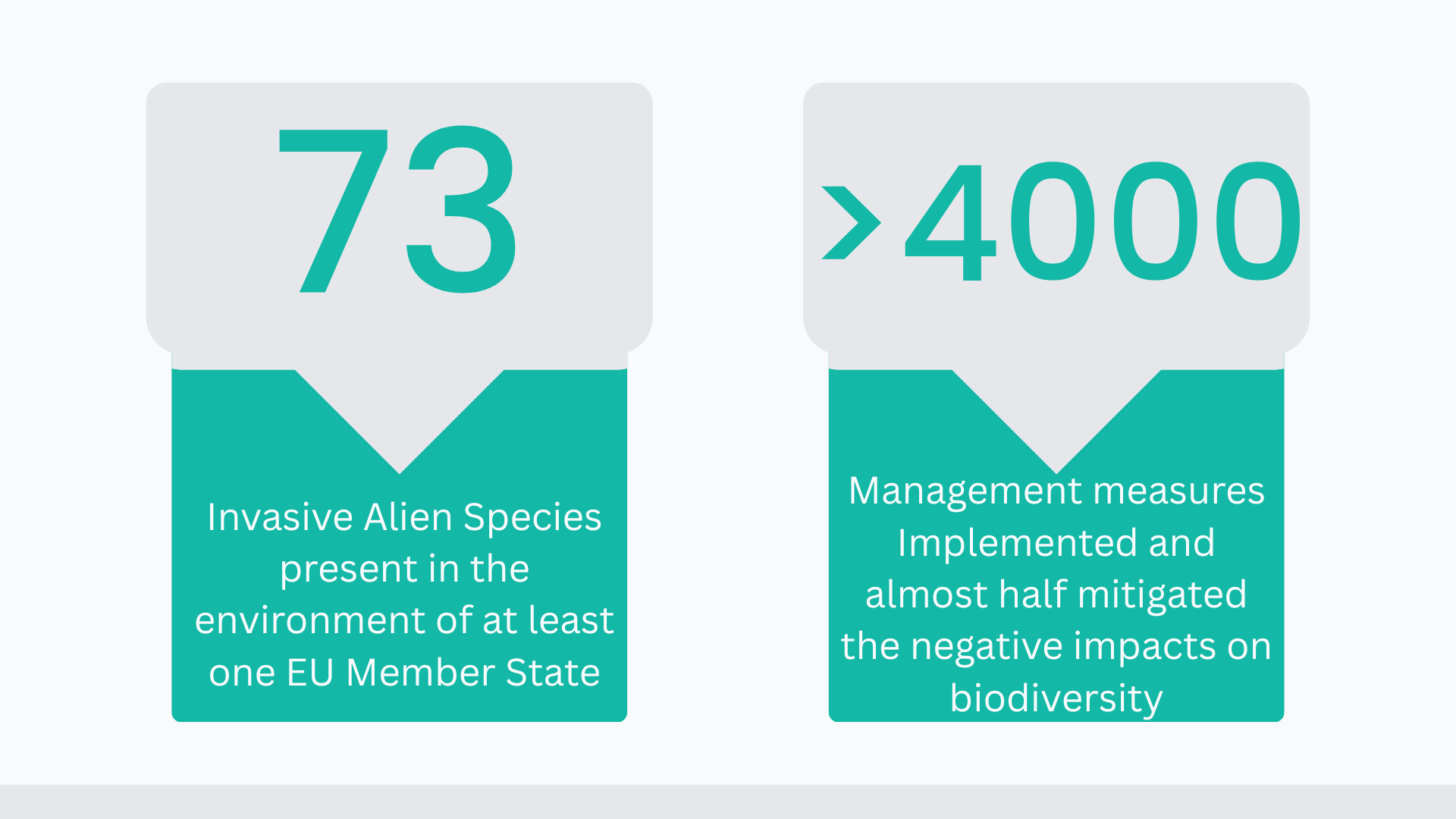
More than 4,200 management measures were also implemented for invasive species that are already established and widespread. Over half of these measures have already contributed to reducing their negative impacts on biodiversity, while the effectiveness of the remaining measures is still being monitored.
The number of Member States implementing rapid eradication measures has increased significantly compared with the previous reporting period. This indicates that the European system for early detection and rapid response is gradually becoming stronger.
Invasive alien species are present in all Member States
Despite the progress, invasive alien species continue to spread across Europe. Species of Union concern, namely species whose negative impacts require coordinated action at the European Union level, have been recorded in the wild in all Member States.
The highest numbers of different invasive alien species have been recorded in densely populated areas, along major rivers, and near major transport hubs such as seaports.
During the reporting period, the presence of 73 invasive alien species of Union concern was confirmed in at least one Member State. Some additional species are kept under strictly controlled conditions through permit systems.
Existing invasive alien species are expected to continue spreading, while new species are likely to arrive in Europe. Continued investment in prevention, monitoring, early detection, and rapid response is therefore essential.
What do the data show for Croatia?
For the period 2019 to 2024, Republic of Croatia reported to the European Commission records of 28 plant and animal species from the Union List that have been detected within Croatian territory, as well as ten invasive alien species included on the national Black List.
Like other Member States, Croatia implements measures for the early detection and rapid eradication of newly introduced invasive alien species. During the reporting period, rapid eradication measures targeted three species from the Union List: floating primrose-willow, the Egyptian goose, and the sacred ibis.
The rapid response to the occurrence of floating primrose-willow was not successful. During removal efforts from aquatic ecosystems, small plant fragments spread quickly through canals and waterways. As a result, public institutions that manage protected areas continue to invest significant human and financial resources each year in its removal and control.
A successful rapid response was carried out for water lettuce (Pistia stratiotes) in 2017 in Zagreb County and again in 2023 in Međimurje County. Since the first record and first rapid response occurred before the start of the current reporting period, water lettuce is not listed among the new invasive alien species reported for the 2019–2024 period. Staff of public institutions that manage protected areas continue to monitor for its possible reappearance every year.
The most recent first detection of a species from the Union List in Croatia was recorded on 15 October 2023 and concerned the Egyptian goose. In this particular case, rapid response measures were not implemented because the bird flew to another location before nature conservation officers arrived.
Croatia is required to report every early detection of an invasive alien species from the Union List through the European NOTSYS – EASIN Notification System. Rapid eradication measures must be undertaken within three months, and all notifications recorded in the system are included in reports for the corresponding six-year reporting period.

Further information